On this page
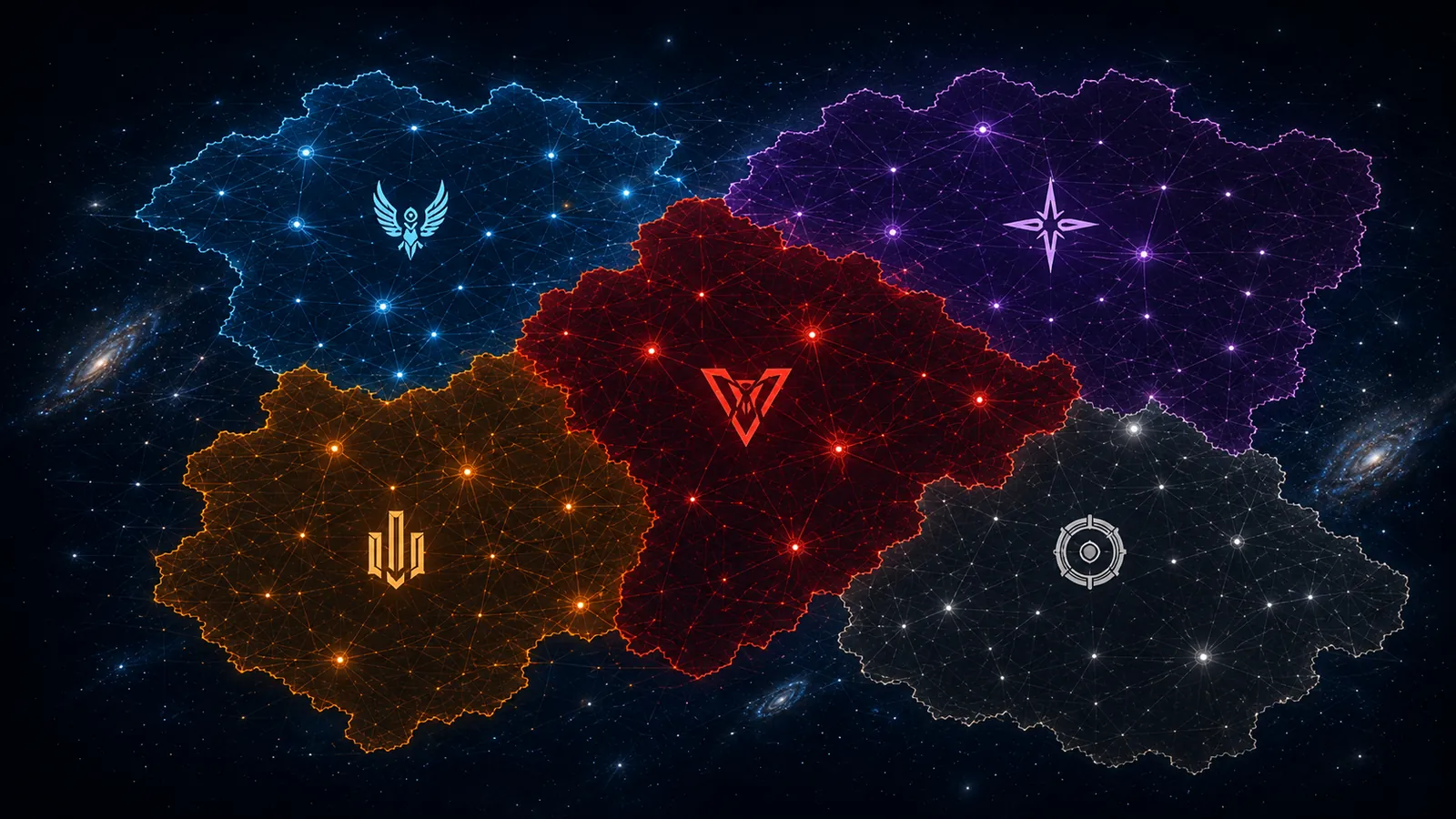
Where to establish a colony, which planet is best, and why distant destinations are “expensive”—it all comes down to coordinates and orbits. Let’s take a look at how the Xterium map is structured and how to choose a good planet. The numbers are taken from the game’s code.
Where did this guide come from? The orbits, temperatures, and sizes of the planets are taken directly from the game's code. Tips on choosing planets come from the community (wiki, forum). The planets themselves are listed in the encyclopedia.
How Coordinates Work
A planet's address consists of several parts: galaxy → arm → system → position (orbit). The greater the difference between the target’s coordinates and those of your planet, the greater the distance—which means the fleet takes longer to travel and consumes more deuterium. According to the game code, the factors contributing to distance, in descending order, are: another galaxy (the longest jump) → spiral arm → system → neighboring planet (the shortest). A flight “in orbit” (toward your own planet) is the shortest.
Practical conclusion: Closer colonies and destinations are always more efficient in terms of fuel and time. For more details on the flight, see the article “Fleet Speed and Fuel Consumption”].
A planet's orbit determines its temperature
A planet's position in the system (its orbit) determines its temperature. According to the code, there are eight groups of orbits, ranging from the hot inner orbits to the icy outer orbits:
| Orbit | Temperature |
|---|---|
| 1 (near) | +225…+275 °C |
| 4 | 0…+75 °C |
| 5 | −75…0 °C |
| 8 (far) | −275…−225 °C |
Temperature is important for deuterium: on cold, distant planets, deuterium is extracted more easily, while on hot, nearby planets, solar satellites operate more efficiently. For more details, see the article “Temperature and Deuterium”].
The size of the planet is the land available for development
A planet’s “size” is the number of tiles on which buildings are constructed. According to the code: tiles are generated randomly, with approximately 200–270 per orbit (meaning that size does not depend on the orbit—a cold planet is not necessarily small). The starting (home) planet has 250 tiles. Additional tiles are provided by special buildings—the terraformer (+5 per level) and the lunar base.
Conclusion: When choosing a colony, consider both the temperature (based on your needs) and the number of fields (the more fields, the more buildings you can fit).
How many planets can you have?
According to the code, a player can have up to 8 planets (including their home planet). Colonies are established by sending a colonizer to an unoccupied slot in a selected system. Plan your planet layout: some for deuterium (cold), some for energy/satellites (hot), and all close to each other for cheap travel.
How to Choose a Good Colony (Tips from the Community)
- Proximity — Settle near your planets and your alliance: logistics are cheaper, and help and saves are faster.
- For deuterium, choose cold, distant orbits (6–8).
- Satellite power comes from hot near-Earth orbits.
- Size — if you need the planet as your main base, look for one with more fields; a small one can be expanded using a terraformer.
- Neighbors—take a look around to see who’s nearby: aggressive, powerful neighbors = constant attacks.
Frequently Asked Questions
How many planets can you have in Xterium? Up to 8, including the homeworld. Colonies are established by a colonizer at an unoccupied location in the system.
What determines the planet's temperature? Based on orbit (position in the system): inner orbits are hot (up to +275 °C), while outer orbits are cold (down to −275 °C). Temperature affects deuterium production.
Does a planet's size depend on its orbit? No. Fields (200–270) appear randomly on any orbit. Their size can be increased using a terraformer.
What to Read Next
- Temperature and Deuterium
- [](/knowledge/mechanics/skorost-i-rashod-flota) Fleet Speed and Fuel Consumption]
- How to Develop the Economy
- [](/knowledge/encyclopedia/planets)'s Planets in the Encyclopedia